How to Become an Independent Recruiter (And Why You Should)
Thinking about leaving your agency to recruit independently? The honest breakdown of the financial reality, the infrastructure you'll need, and the path forward.

How (and Why) to Go Independent as a Recruiter
If you're good at recruiting, you have two real options: work for an agency or work for yourself.
An agency provides structure, community, a higher floor but a lower ceiling. For early-career recruiters, it is an invaluable starting point. But when you reach the stage where you are winning your own clients and managing your own pipeline end-to-end, your agency quickly turns into the world's most expensive administrative assistant.
Going independent has its own drawbacks too. Recruiting is naturally competitive and social, so it can be lonely to work by yourself. For some people, it's difficult to drum up the motivation and start dialing without a team around you. You are also responsible for setting up all your tools and platforms, doing all your own admin and back-office, configuring and troubleshooting your CRM.. and all that boring day-to-day stuff adds up. You also need to set up your business structure, do your own taxes and get business liability insurance. Juggling a million different jobs at once can get overwhelming quickly, especially if all you really want to do is recruit.
This is actually the main point of failure for recruiters trying to go solo. Not because they can't recruit but because they're too busy drowning in all the other crap.
The Brutal Truth
According to Jon Smith, a veteran executive recruiter at the Taplow Group, most people who try to go solo in recruitment fail within 12 months. These are typically good recruiters, maybe even top billers at their old agencies, but they always underestimate 3 important things:
- Cash-flow gaps: Even if you manage to bill in month 1, you don't get paid until month 4. And what happens if they are late? Then you have to deal with a whole new layer of admin complexity, chasing down invoices while surviving on fumes is the quickest way to failure.
- Infrastructure and admin complexity: CRM, legal, accounting, compliance; none of it comes for free or sets itself up.
- Isolation: No colleagues, no sounding board, no shared intelligence, no social element.
The Financial Reality
Agency recruiters are incentivized by the possibility of reaching the 30% commission tier or making "lunch club" for hitting 3 placements in a month. By the way, those 3 placements alone are probably generating upwards of €70k for your agency, but hey, at least you got a nice lunch out of it.
When you make a 30% commission on your placement, it's easy to forget that means you’re losing 70%. Where is that going? (Hint: check your boss's driveway.)
At an average agency, if you bill €200k in a year, you might take home €60k (before tax) if the commissions are generous. If you bill €200k working for yourself, you are keeping at least €170k. You are nearly tripling your income for the same amount of work. If you just want to maintain your income at €60k we are talking about needing to make 3, maybe 4 placements in a year. Easy right?
The table below shows what this looks like across different billing levels.
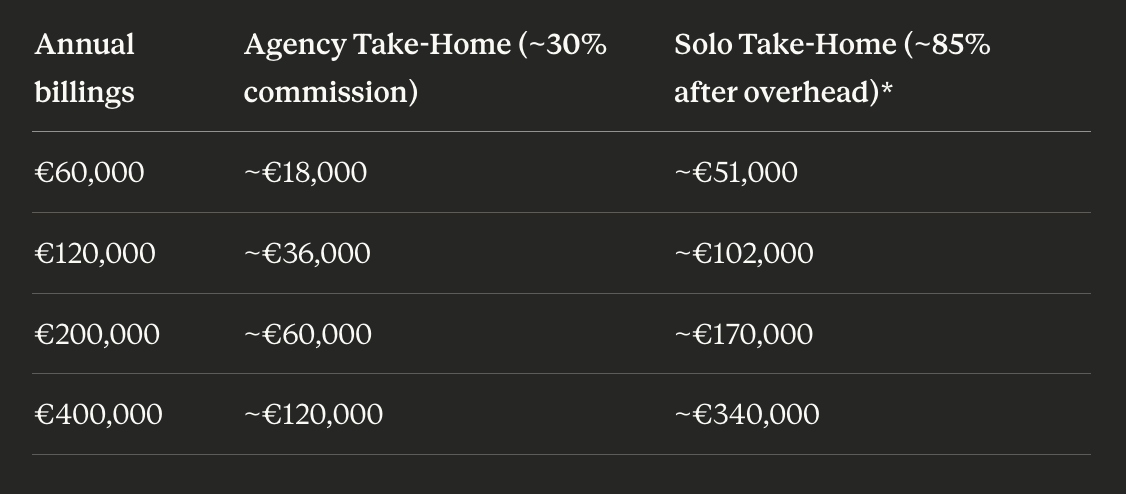
*Illustrative purposes only. Exact numbers vary depending on agency, industry and market.
Now, for fun, let’s zoom into a hypothetical quarter. A quarter where you only make a single placement.
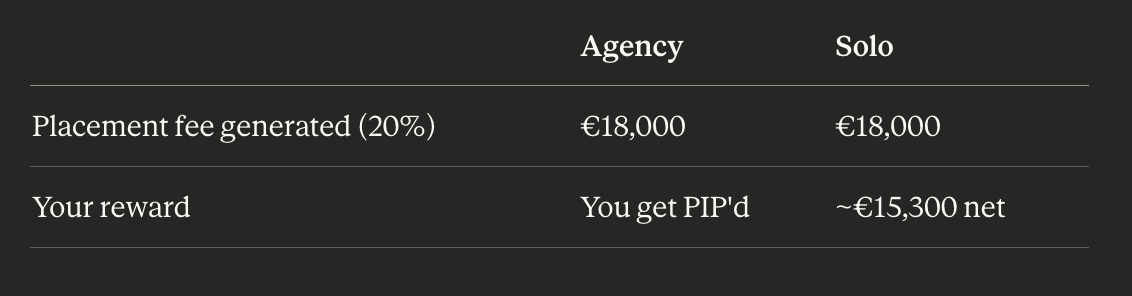
Same effort, same work. One results in a performance review and the other results in €15k+ in your pocket.
The Infrastructure
This is the part where most recruiters realize they didn't actually want to start a business, they just wanted to recruit without a boss.
The Dutch Legal Foundation
In the Netherlands, it starts at the KVK. You'll have to choose between an eenmanszaak (sole proprietorship) or a BV (limited liability). An eenmanszaak is easy to set up but leaves your personal bank account and assets vulnerable; a BV is a tax-efficient fortress but comes with thousands in setup costs and strict salary requirements. Then comes the VAT (BTW) registration. Suddenly, your calendar isn't just filled with interviews; it's haunted by quarterly tax deadlines and the looming threat of the dreaded blue Belastingdienst envelope arriving at your door.
True story: A few months after I first set up as an eenmanszaak (ZZP), before I even made a dime, I got a letter in the mail from the Belastingdienst telling me that I owed them €5000. I called them in a panic and when I finally got through, they informed me that I didn't submit my quarterly VAT return, so they assumed my income. Luckily they said that if I submitted it by the end of the day, they would waive the €5000 and I would only have to pay a €80 penalty. I have never been so happy to pay a fine in my life (and I never missed another VAT deadline again). Learn from my mistakes!

The Tech Stack (Your Digital Overhead)
You need the tools to compete with the big shops, but you don't have their bulk-discounted enterprise licenses.
- The CRM: You could try to "build your own CRM" on Excel, but this honestly sounds like a nightmare. You'll eventually need a real CRM/ATS.
- The Reach: A LinkedIn Recruiter seat is non-negotiable, and it's arguably the most expensive subscription you'll ever own. You could get away with LinkedIn Recruiter Lite but it's still not cheap.
- The Rest: Job board credits, sourcing tools, a productivity suite and a website + SEO.
The Damage: You are looking at a €500-€1,500 monthly burn rate just to keep the lights on. That's money leaving your pocket every month whether you make a placement or not.
The Back-Office "Silent Killers"
This is the "boring" stuff that can actually sink you. You need professional-grade Terms of Business (ToB). If your contract is weak, a client might "forget" to pay your invoice, and you won't have a legal leg to stand on. You 100% need Professional Liability Insurance because if a candidate you placed accidentally nukes a client's database, you don't want to lose your house in the settlement. In fact, most legit clients won't even work with you unless you have a good insurance policy. And since we're in the EU, GDPR compliance is an ongoing headache of data retention policies and "Right of Erasure" requests.
If you think recruiting is hard, wait until you're trying to debug a broken ATS integration between screening calls, while a client is breathing down your neck about a GDPR-compliant Data Processing Agreement you haven't written yet, while you're still waiting on your other client to pay you, but they won't send any money until they receive proof that you own your bank account, which you already requested from your bank and paid them €35 to send it to you 10 days ago, but it still hasn't arrived for some reason and no one can give you an answer as to where it is. Going solo means you are no longer just a headhunter; you are now IT Support, CTO, CRO, lawyer, accountant, HR and anything else your company needs on a given day.
The Timeline
Expect it to take 6 to 12 months to get fully operational. Not to make your first placement, but to build a scalable system that doesn't require you to work 80 hours a week. It's timely, it's expensive, and for most people, it's too much.
The Paths Forward
If you've already decided you want to go solo, now the question is how are you going to do it? There are two primary ways to leave the agency world, and the right choice depends entirely on whether you want to be a business administrator or a high-billing recruiter.

Path 1: The Pure Soloist
Build it from scratch. This is the purist's route. You go to the KVK, you pick a name, you build the website, and you buy every single subscription yourself. You manage every part of the business. You are the CEO, but you are also the person who has to fix the printer and chase down that client who is 6 months late on a €20,000 invoice.
Best for: Recruiters who genuinely enjoy the "builder" aspect of business. Those who want to own 100% of the brand and don't mind spending a significant chunk of their week on non-billing activities.
The Reality: It is the ultimate freedom, but it is also the ultimate burden. When the CRM breaks, you're the help desk. You celebrate your wins by yourself. You absorb the losses by yourself. You have total autonomy, but you are also totally alone.
Path 2: The Network Model (Strategic Autonomy)
The network model is plug-and-play. You bring the expertise; everything is already there. Think of it like a turnkey ‘business-as-a-service’ for you. Your recruitment business is ready right out of the box; but you still run your own desk, your own clients and your own relationships.
Best for: Top billers who want to spend their time recruiting. They know that every hour spent troubleshooting their CRM or working on GDPR-compliance is an hour they aren't closing deals.
The Trade-off: You aren't "purely" solo because you're part of an ecosystem, but in exchange, you strip away 90% of the "crap" that causes solo recruiters to fail in their first year. It's the "Best of Both Worlds" option: the upside of independence with the safety net of an agency.
Ultimately, you have to ask yourself: Do you want to spend your Sunday nights auditing your tech stack, or do you want to spend them prepping for the candidate submittals that are going to pay your mortgage for the next year?
Why Now Is the Right Time
People often ask, "Is now a good time to go solo?" The answer has nothing to do with the current state of the economy and everything to do with the fundamental shift in how recruiting actually works. The traditional agency model is built on high fixed costs and structural bloat. Impressive in scale, but slow to adapt and expensive to keep afloat. In the modern market, fast and lean operations win.

The Myth of the "Safe" Agency
The biggest misconception in our industry is that recruiting for an agency is the safe choice.
When the market is hot: 80% of your billings are going towards funding new office leases, fat bonuses for the suits or a hiring wave of junior recruiters who need training. You are essentially funding the agency's growth while capping your own.
When the market is slow: You become a liability on a balance sheet. Agencies protect their margins by squeezing yours. They raise KPIs, slash budgets, and make layoffs.
The End of the Gatekeeper Economy
The traditional agency was built for an era of information scarcity. Twenty years ago, the firm's database was a genuine competitive moat; a locked server or physical filing cabinet that only the agency could access. If you wanted to reach the market, you paid the gatekeeper their 70% cut.
Today that Black Book is LinkedIn. Everything else can be replicated with an internet connection and a few sourcing tools.
The Broader Shift
This isn't unique to recruiting. Across the professional world, technology has allowed the individual to bypass the institution:
- Media: Independent creators with niche audiences are making sustainable livings without labels or publishers.
- Professional services: Senior partners are leaving Big Four firms to run lean boutique practices, offering better rates to clients while doubling their own take-home.
- Online marketplaces: In sector after sector, individuals now reach clients directly without needing a big brand behind them.
Recruiting is one of the last professional services where the institutional model hasn't fundamentally changed since the 1970s. Back then, you genuinely needed the firm for its infrastructure. In 2026, the agency keeping 70%+ of your placement fee is just tradition.
Pre-Flight Checklist
Going solo shouldn't be a "leap of faith"; it should be a calculated move. Before you hand in your notice, you need to know exactly which clients you're targeting and whether your bank account can survive the "cash-flow canyon" of the first six months.
- 9-12 Months of Operating Capital: This covers your business overhead (business registration, software, legal, insurance etc.) AND your personal living expenses. You can't recruit effectively if you're panicking about next month's rent.
- A Defined Niche: To thrive solo, you need to be "the person" for a specific, high-value vertical. Don't try to be a generalist.
- 2-3+ Years of Experience: You need to be far enough along that you aren't still learning how to recruit while you're also trying to learn how to run a business.
- A Plan for Infrastructure: Don't wait until you've quit to decide how you're going to build your stack. Are you going to build it yourself, buy it piece-by-piece, or join a network that provides it for you?

Why We Built JMK
The infrastructure wall described above shouldn't be the thing that stops a genuinely talented recruiter from going independent. But for most people, it is. Not because they can't figure it out. Because it takes time, costs money, and kills momentum right when you need it most.
JMK gives independent recruiters a platform, CRM integration, contracts, email and phone, sourcing tools, back-office support, and shared brand credibility. You recruit under the JMK banner, we handle the client contract and invoicing, and you keep the majority of the fee. No non-competes. No salary caps. No territorial restrictions.
Most people could technically change their own oil, renovate their own apartment, or do their own taxes. The question isn't whether you're capable. It's whether that's the best use of your time.
If you want to understand how the network model works in practice, you can read more here or reach out directly.